David Cant
Coaching for safety leadership

Six step approach to safety coaching

Have you considered safety coaching when employees don’t follow the rules? It’s quicker than issuing disciplinary action, which is a managers first thought. Regular safety coaching can also help maintain employees safe working behaviour when you observe it being done.

As I tweeted the other day safety coaching does not take long.

A six-step approach to safety coaching you can try yourself

Step 1. Coach in the moment

Step 2. You go up to the worker

Step 3. State the behaviour you observed

Step 4. Ask open-ended questions. What? How? Why?

Step 5. Have a short conversation and listen

Step 6. End on a positive note and with praise

How a conversation can play out

Picture Bob working on a lathe.

Safety Supervisor – “Hey Bob, I noticed you were wearing eye protection while turning that component. What’s it like wearing safety glasses?”

Bob – “Absolutely fine. It’s not a problem.”

Safety Supervisor – “And you still followed the safe working procedure. So tell me, why is wearing eye protection so important?’

Bob – “Because if I didn’t wear the glasses, I might risk suffering an eye injury from a flying object.”

Safety Supervisor – “That’s great, Bob. Keep it up. You set a good example for others. Have a great day.”

Safety coaching takes minutes.

Having conversations to remind employees of the Why? helps maintain safe working behaviour and good habits.

I can help. If you are curious about how I can help you with safety coaching techniques, send me a message on 07814 203 977, or use the contact form below or if you prefer, book a 15-minute virtual call. to talk things through.

Managing Stress and mental health at work

How Can Safety Managers Minimise Stress In The Office?

It’s been a stressful year for most of us. Between the constantly changing coronavirus situation and a majority shift to working from home, many of us have likely found our stress levels rising.

Alternatively, the shift to homeworking may have helped relieve the stresses of office working, and now the idea of returning to the office may have employees anxious and worried.

Whatever the cause, managers and those with a responsibility for workers’ health need to be prepared for stress to make its way into the office following return to work. Although the focus might (rightly) be on ensuring the office is COVID-safe or that risk assessments consider all potential physical dangers, the stress in employees must be identified and managed before it becomes a problem.

COVID stress

We all get stressed once in a while. Whether it’s because of a change in life circumstances, too much work, or lack of support, stress is a natural bodily response. During the COVID-19 pandemic, however, the levels of stress rose dramatically due to uncertainty about job losses, confinement, and more.

Following the almost overnight shift to home working, 1 in 5 people said their work had been affected because they found working from home ‘difficult’, according to the ONS.

During the first lockdown, 37.4% of adults in the UK stated that the pandemic had affected their well-being. Though normality is resuming, it is still an uncertain time, and another shift in the way people are used to working could trigger more stress and anxiety yet.

Managers need to be eagle-eyed in spotting stress and anxiety in returning workers before it takes root.

How stress impacts work

In recent years, greater emphasis has been placed on tackling stress and anxiety at work. However, nurturing employee mental health remains a low priority in many businesses across the country, despite the impact of poor mental health amongst employees on efficiency and quality of output.

According to Chris Parker, CEO of employment coaching firm TalkingTalent, work-related stress accounted for almost half of work absences and cost British businesses upwards of £26bn in 2019. This will have surely only risen over the past year.

High levels of stress aren’t good for anyone, and businesses need to consider the cost stress has, both in terms of the human toll and the bottom line.

However, more concerning for those with health and safety responsibilities is how high levels of stress can seriously hamper risk management and make it more difficult to achieve a culture of collaborative safety.

Morale and motivation: Even the best workers can get burned out. If they don’t feel like what they’re doing is impacting, then where’s the motivation to try? This can be particularly dangerous in the area of safety and risk management, with employees cutting corners and even ignoring carefully thought out procedures to get the job done faster.

Substance abuse. Stress can trigger mental ill-health and drive people to substance abuse in an attempt to get through the day. In serious cases, employees may start coming to work under the influence, putting themselves and others at real risk of injury or worse.

Absenteeism. When burnout gets bad enough, employees may start missing work. This can obviously impact their performance and output and make the jobs of risk managers more difficult, as you might not have a correct account of who’s in and who’s not. In addition, if an emergency strikes, it can be harder to do your job of keeping everyone out of harm’s way.

High staff turnover. If stress levels are too high or are not being mitigated properly, staff turnover rates can rocket. Not only does this contribute to poor work culture, but it also means trouble for health and safety managers. Each new worker means extra training, and it can be difficult to keep track of who’s up to date and who’s not. That’s not even considering the extra cost – both financial and in terms of precious time – to the health and safety budget.

Stress is bad for everyone, and it pays dividends to both employees and managers to nip it in the bud. So, what can you do as a health and safety manager to identify and minimise it before it becomes a problem?

Identifying and tackling stress at work

According to the HSE, employers have a duty to identify and assess stress as they would any other risk to health. The most obvious signs of stress in the workplace are:

  • arguments
  • higher staff turnover
  • more reports of stress
  • more sickness absence
  • decreased performance
  • more complaints and grievances

Signs specific to employees themselves are:

  • absenteeism/lateness
  • nervousness or ‘twitchy’ behaviour
  • mood swings
  • being withdrawn
  • loss of motivation, commitment and confidence
  • increased emotional reactions: being more tearful, sensitive or aggressive

One of the most straightforward ways of identifying how much impact stress is having is with a risk assessment. First, identify potential stress triggers and assess how likely they are to cause trouble as you would with physical risks. I’ve talked previously about how risk assessments don’t need to be big exercises in paperwork – use your initiative and record the important stuff.

According to the HSE, there are six main triggers for stress at work. By identifying the trigger, you can begin working with the employee, colleagues, and managers to ensure the issues are resolved before they cause real problems. You must be active rather than reactive, so always be on the lookout for the signs above.

Overly demanding roles or overwhelming workload

This is one of the main triggers of ‘burnout’, where the employee can’t deal with the amount or type of work they have. This can be common in smaller businesses where workers do the work of several people or where management systems have broken down and work is being passed on without regard for capacity.

In these cases, you should work with both the employee and their manager to modify the employee’s role where possible, to either minimise or adjust their work to make it more manageable.

Encourage managers to bring in additional resources or implement job enrichment and task rotation. Workloads must be managed properly, and employees shouldn’t be regularly working with unrealistic deadlines. Similarly, employees must be empowered to reject work if they do not have the capacity.

Lack of control

It’s crucial that employees feel that they have control over their job and that their concerns are taken seriously. I’ve blogged previously about how important psychological safety at work is, and this can be encouraged by regularly requesting input from employees about how work could be better managed, and ensuring that these ideas are passed up the chain to decision-makers.

It would help if you worked with managers to encourage them to trust and empower employees to manage their own workload and avoid micromanagement. Steering employees in the right direction is far more powerful than ordering them to do something. Regular training can also be highly beneficial in giving employees a greater sense of control.

Lack of support

This can be a big one, especially in larger businesses with many employees or big teams. Nonetheless, employees mustn’t be left to fall through the cracks and get the support they need. Work closely with managers to foster a supportive atmosphere: a few small changes can go a long way.

Managers should always make time for praise and acknowledge employee efforts and be on hand to help when an employee highlights an issue. Conversely, any criticism must be constructive and followed up with solutions. Managers should also be conscious of outside pressures on the employee, such as family or financial trouble, to ensure criticism isn’t simply adding to the pile. Finally, where necessary, managers should always be flexible and allow for time off when needed.

Issues with other colleagues

Humans nearby will always have conflicts; it’s just a fact of life that we don’t get along well with everyone. However, you can minimise the impact these conflicts have on the workplace by partnering with managers to ensure issues are properly handled and that employees feel comfortable talking about the problem without judgement or bias.

Managers must listen objectively to both sides of the conflict and properly investigate complaints rather than ignoring problems and hoping they’ll go away. Prevention is always the best treatment.

As a third party, you can often assist by ensuring the discussions remain positive, unbiased and that everyone stays calm. Once a dialogue has been opened, you can also be on hand to ensure any changes promised are implemented.

Conflicting/unclear job demands

No one likes to be left in the dark. If employees are regularly tasked with projects without the right context, information, or training, it will eventually lead to stress. It is crucial that managers are clear in what the objectives of each role are and clearly communicate any changes to these roles.

Similarly, in fast-paced businesses, care should be taken to ensure employees are not being overloaded with tasks from other managers or are not being given projects that conflict with existing objectives. Again, regular meetings and open lines of communication are crucial here.

Unexpected/constant change

It’s only natural to fear change, especially when change can impact us negatively, and fear of change can become a serious stress trigger when it is constant.

Thankfully, it’s relatively simple to minimise the effect change has on your employees. Simply keeping them in the loop with regular communication can be powerful. No one likes to hear big news on the grapevine, and rumours can spread quickly. By ensuring team leaders clearly communicate potential changes and offer support where needed, the potential impact can be minimised.

How can I help?

Stress can have a major impact on proper risk management and health and safety, but real solutions are all too often ignored to favour quick results or more immediate concerns. As a health and safety manager, you are in a unique position to help tackle stress in the workplace before it causes serious problems.

With over two decades in the health and safety sector, I’ve worked with plenty of businesses to minimise stress and ensure the wellbeing of employees and, subsequently, the bottom line. So if you think I might help you, get in touch on 07814 203 977 or use my online contact form.

Safety Coaching - David Cant

Set your sights higher with safety leadership coaching

Safety and risk management at work is easy.

When you spot someone flouting the rules, all you need to do is pull them aside, show them your laminated safety posters on the office corkboard, give them a telling off, then send them on their way with a newfound passion for safety.

Except that’s not really how it works at all.

Let’s be honest: no one has ever changed how they do things because someone told them off. Very rarely has someone skipped out of a meeting with the health and safety boss inspired to change their ways.

Just telling the worker what they did wrong isn’t going to do much because, in reality, they already knew what they were doing was wrong. They decided to do things their way for a reason, and it’s your job to figure out what that reason was.

The human factor, which I’ve discussed previously, is one of the most unpredictable parts of risk management on construction sites and beyond. It’s the health and safety manager’s responsibility to identify the triggers for rule-breaking and tackle them at the source.

Telling v motivating

No one wants to be told what to do. Very few people respond well to orders, especially when they’re being reprimanded.

Sometimes, pulling an employee up on something is an unfortunate necessity. If their actions put others at risk, or it isn’t the first time they’ve flouted the rules, then discipline is important.

However, if you find that all you’re ever doing is challenging people for breaking the rules, or it’s your go-to tool for enforcing safety policies, then you might be coming at things from the wrong angle. Too much modern health and safety is built around tackling safety behaviours after issues appear, rather than encouraging the right behaviours and skills from the start.

Ultimately, people won’t do something (or won’t stop doing something they want to do) without a good reason. So how do you find the right motivation?

The right motivation

To find this motivation, you need to go above and beyond the standard ‘person with a clipboard’ persona. It would be best if you moved away from the traditional compliance-based approach (‘stop doing this because the law says so’) to identifying motivational triggers and apply a coach-like approach instead.

There’s no one size-fix-all for creating a truly effective safety culture in the workplace, especially when it comes to motivation. Every person’s motivational ‘sweet spot’ will be different, and different people need different triggers.

To find and encourage the motivators on your site, you could look beyond what isn’t working and look at what is. Why? Can you repeat it?

Make sure you’re reviewing people as individuals rather than a single monolith. Then, you can provide real supportive feedback on what they’re doing well and what they could do better. I’ve blogged previously about how to properly motivate staff to want to be safer.

These strategies and others will allow you to coach your team more into putting thought into health and safety. However, to see real changes in your staff, you might want to consider setting your sights slightly higher.

Focus on leadership

One of the worst mistakes a health and safety manager can make is assuming that only the workers on the ground need to be thinking about safety.

From my experience in the safety industry, I know first-hand that some of the most powerful changes come from above. I’m not talking about managers coming to the site and throwing their weight around. I’m talking about real changes from the top down.

For a business to have a truly effective safety culture, everyone needs to play a part: this includes managers and directors. When a company’s leadership shows real support for safety in their messaging and behaviours, it cascades down to the rest of the business. How can directors expect their employees to care about health and safety if they don’t?

When management shows a real, sincere commitment to safety, it encourages others to do the same. Workers do what managers do.

As the health and safety professional in your business, you should be putting at least as much effort into targeting the safety behaviours of management and leadership as you are into workers’ behaviour.

By implementing a safety leadership coaching strategy, you might soon find that you’re fighting fewer fires, and employees are more receptive to your risk management policies.

Hopefully, you can work directly with a leadership team, letting them know about the effect their sincere input could have on the business’s safety culture. However, you may have a tougher job if your business doesn’t put much stock in psychological safety.

For the most part, however, leaders will usually want to do what they can to improve safety when they know the benefits. A stronger, more well-rounded safety culture doesn’t just mean safer workers, but fewer potential legal issues and a much lower impact on efficiency, saving time and money. A safer business is a healthier business.

There are multiple ways to get leadership involved in safety. Directors should be sitting in on important safety briefings, taking notes, and showing a real interest in improving safety and wellbeing across the business.

Leaders are often unaware of how their leadership skills, communications, behaviour and even their body language can affect employees’ outlook, especially when it comes to safety. No one wants to work for a company that doesn’t care. This is why safety leadership coaching can be so powerful.

Via proper leadership coaching, management and supervisors can identify their own safety weaknesses. They can also learn the real benefits of better company culture, encouraging them to take an active role. Being more curious and asking questions. Once a leadership team is seen to be taking a sincere interest in safety, those throughout the company have a reason to do the same.

Bring in the big guns

I know first-hand how difficult it can sometimes be to instigate change from within a business. This is even more obvious when it comes to working with leaders: directors and management have a thousand and one things to deal with, and it can be hard to get face time to tackle the issues. Sometimes, you can be too close to the problem, and your pleas fall on deaf ears.

This is where external safety leadership coaching can make a big difference. By bringing in a third party, you can schedule coaching sessions in advance, creating a sense of obligation, and making it more difficult to avoid the issue.

Third-party safety consultants with a coach-like approach such as myself can also bring a fresh perspective, helping you and those in positions of leadership to identify issues with a safety culture that you may not have even thought about.

If there’s a deadlock when it comes to safety leadership, an unbiased consultant can help break it and get everyone back to the important work of improving safety.

Getting leaders involved in safety can be one of the most powerful tools in a safety and risk manager’s arsenal. When directors and managers show real willing and involvement in safety at work, it inspires others to do the same, allowing them to internalise the teachings and creating a sustainable safety culture.

I have two decades of experience in safety and risk management which includes coaching managers and supervisors to become good leaders. If you are curious about how I can help you, send me a message on 07814 203 977, or use the contact form below or if you prefer book a 15-minute virtual call. to talk things through.

psychological safety in construction workplace

The Importance of Psychological Safety On Your Site

We’ve likely all had thoughts about ways to improve processes at work – in safety and beyond – no matter what role we’re in.

Unfortunately, not everyone feels comfortable enough to voice their opinions at work, either due to fear of judgment or the risks of punishment in poorly managed workplaces, where employees’ opinions are not high on the priority list.

In workplaces where potentially fatal risks are everywhere, such as in construction or manufacturing, ignoring or reprimanding workers for voicing their opinion can have a serious impact on that particular employee and their safety and wellbeing.

What is psychological safety?

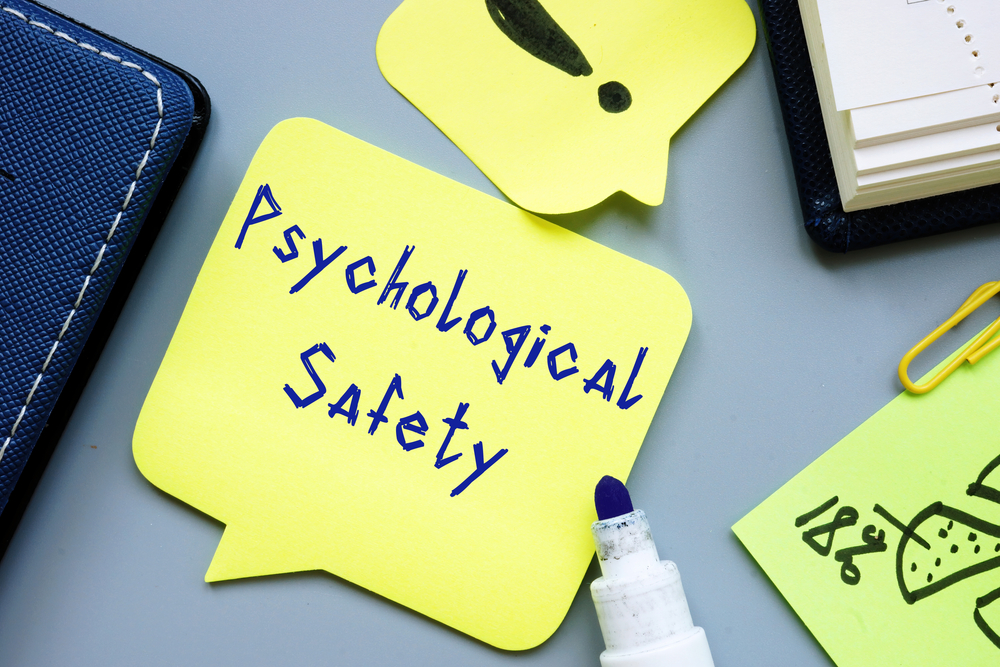
Feeling comfortable enough to voice our concerns, whether at work or beyond, is called ‘psychological safety’. It is essentially the belief that our opinions and points of view will be respected if shared, and we won’t be mocked or punished for voicing them.

One of the leading voices in psychological safety, Timothy R. Clarke, said: ‘Psychological safety is about removing fear from human interaction and replacing it with respect and permission.’

In 2008, search giant Google carried out a comprehensive survey to find out what exactly makes an effective team. Carrying out 200 interviews with over 180 active Google teams, the researchers found that the highest performing teams had one thing in common: psychological safety. The team members felt comfortable sharing ideas and support in pursuing goals that might not have been a safe bet.

The benefits of psychological safety for businesses like Google are clear: they thrive on innovation and need employees to feel safe enough to voice risky ideas. What is the benefit of psychological safety in other, more traditional industries, such as construction?

Psychological safety in construction and industry

Construction and labour-intensive industries are a world away from Silicon Valley. Despite recent modernisation, these are generally traditional industries where ’this is the way we’ve always done it’ is a sacred phrase.

There has been a noticeable divide between the new blood entering the workforce with fresh, novel ideas and the conservative old guard, who can be resistant to change in recent years.

This resistance can take the form of managers and senior workers, who may be set in their ways, outright rejecting or even belittling potentially beneficial ideas favouring the tried and tested. Conversely, experienced workers who have utilised their wisdom to identify new ways of working might be told to stay in their lane. Businesses that do not emphasise supporting new ideas run the risk of limiting their growth and seriously impacting workers’ mental health, who will eventually either leave or become apathetic to their role.

More crucially, however, an atmosphere in which employees are ignored, mocked, or even disciplined for speaking up can, in many cases, even be dangerous.

If workers feel like their word means nothing, they might decide it’s not worth saying anything if they spot a potential danger or risky process. The input of workers on the ground every day is one of the most important tools in combating the human factor.

Is your team psychologically safe?

You can generally tell at a glance the general measure of psychological safety on your team. Do employees often come to you with things they’ve noticed or ways to improve processes? Have you noticed employees supporting each other in bringing their concerns forward?

There is a way to quantitively measure psychological safety if it’s a concern for you, using the Likert Scale. It would help if you asked your team the following questions, then ask them to anonymously score themselves on a scale of 1-5, with 1 being low and 5 being high.

  • On this team, I understand what is expected of me.
  • We value outcomes more than outputs or inputs, and nobody needs to look busy’.
  • If I make a mistake on this team, it is never held against me.
  • When something goes wrong, we work as a team to find a systemic cause.
  • All members of this team feel able to bring up problems and tough issues.
  • Members of this team never reject others for being different, and nobody is left out.
  • It is easy for me to ask other members of this team for help.
  • Nobody on this team would deliberately act in a way that undermines my efforts.
  • Working with members of this team, my unique skills and talents are valued and utilised.

A high score will mean you have a solid basis of psychological safety within your team. A low score indicates you have work to do but is the first step towards improvement.

How can you encourage psychological safety?

Ultimately, the best way to improve psychological safety on your team is to listen, encourage them to listen to each other, and make sure their input is implemented. You can follow the below steps to improve your team’s confidence and reap the rewards.

  • Show that you are listening and engaged. No one likes being ignored, or fobbed off with the standard ‘uh-huh’ or ‘yes mate, send me an email’. Take the time to listen, be present during meetings, and set time aside for employees to bring their ideas forward.
  • Show you’ve heard what they’re saying with a recap. If you’ve been listening, you should be able to reiterate their point. Discuss ways to implement their idea with them, rather than taking it straight to the higher-ups.
  • Avoid blaming and shooting the messenger. If something goes wrong, it’s too easy to blame the guy who brought it to your attention. If an injury occurs, investigate as a team, get the input of others, and ask what can be done to avoid similar future events.
  • Be self-aware and honest. Always be open about how you work and encourage others to do the same. For example, in training, identify who is a visual learner, who is a practical learner, and ensure they receive training most suitable for them.
  • Create a negativity free zone. Building sites and industrial zones are full of banter, and that’s usually fine. However, pay attention to the banter and keep it from getting out of hand. Similarly, if you notice constant negativity from one worker about their peers, nip it in the bud. Talk with them and let them know they need to be a team player and express their concerns professionally. Negativity can spread quickly and wreak havoc.
  • Always include your team in decision making, and be open with feedback. This is the most obvious way to encourage psychological safety, but perhaps the most important. Workers should feel their opinions are valid and affect the workplace: have open forums regarding major workplace changes or risk management. Let them express their ideas and work together, offering feedback and encouragement. When people are listened to, they speak up.

What are the benefits of a psychologically safe workplace?

Google found that psychological safety increased risk-taking, but of course, in cut-throat Silicon Valley, that’s a good thing. In construction and industry, the aim is to minimise risk to everyone. By encouraging psychological safety in your workers, you’ll have more information to work with and a solid foundation to manage risk.

Psychologically safe employees won’t fear bringing their concerns forward, allowing you to act on potential risks more quickly. Generally, you might find that those with daily experience on the job have plenty of ideas to improve and streamline processes, saving you time, money, and stress.

Overall, a psychologically healthy team is a safe team, and it’s something all employers should consider.

For more information, or if you require a safety and risk management consultant, let’s talk things through. Get in touch via the contact options below.

Robotics in construction

Are your Toolbox talks irrelevant?

The best way to make workers ignore safety briefings is to make them irrelevant.

Listen to this practical insight which goes beyond the clipboard to help you improve safety performance and toolbox talks.


shopping trolley wearing mask

Risk Management During COVID-19

Almost one year on from the start of the COVID-19 pandemic, it’s safe to say the world has changed. One area seriously impacted by the pandemic is risk management and health and safety in the workplace.

Working practices have shifted dramatically, and health and safety managers and those charged with risk management have found themselves in a new and challenging environment.

How has risk management been affected by COVID-19, and what can those with safety responsibilities do to counter it?

Impact of COVID-19 on risk management

We are all painfully aware of the changes COVID-19 has had on the workplace in general. Most people not in front-line roles are now confined to their homes, with living rooms, conservatories, and spare bedrooms becoming offices.

But not everyone has been affected by the pandemic in the same way when it comes to working. Health workers are still required to face the public every day, as are other vital workers such as those in the food, shopping, and service industries. Important building and infrastructure works remain ongoing.

These workers are continually exposed to the risks posed by COVID-19 and the general dangers of their particular profession. This is even more concerning now that supervisors, health and safety professionals, and others in charge of keeping them safe are tasked with tackling the new challenges posed by COVID. It is a delicate balancing act to ensure COVID-specific measures are implemented, without neglecting standard, vital health and safety provisions.

Risk management during COVID-19

What steps can you take to identify and manage risks during COVID-19?

Remember people

People can often get so caught up in the other factors of health and safety/risk management; they can forget the most important part: PEOPLE.

Factoring in the constantly changing COVID-19 situation alongside standard risk management means you can lose sight of the people involved. When managing risk, you should always keep in mind that you are dealing with real people, not statistics.

Whether your employees are home-based or working on-site, remember that they are individuals, and their safety is paramount.

Conversely, as I discussed in my recent ‘Human Factor’ blog, human behaviour is the most unpredictable part of safety and risk management. COVID has made this even more apparent: people are stressed, balancing work and childcare, and fearful of the future. It may be more difficult to predict and mitigate risky behaviour. When carrying out your role, remember to be sympathetic and allow for these new factors.

Identify new risks, but don’t forget the classics

As mentioned above, the pandemic has brought with it a host of new challenges. Many businesses neglected to develop robust work from the home policy before the pandemic. These businesses had to scramble to align the new world of home working with health and safety policies as best they could.

Those managing risks in frontline fields faced an even greater challenge. COVID brought a host of new challenges including social distancing and sanitisation, to a greater degree than ever before. Things which were comfortably standard before – such as the number of workers on-site or the length of time between cleaning – became major considerations. The constantly shifting nature of the virus, and sometimes vague government guidelines, made tackling these things difficult and time-consuming.

Despite these new dangers, other risk considerations remain. Work at height on building projects still requires the correct training, equipment, and planning. Human behaviour still needs to be managed. The health of employees needs to be maintained with regularly enforced breaks and ergonomic management.

If you are overwhelmed in your risk management role trying to tackle everything, make sure you communicate. If necessary, ask to recruit support staff, or seek out the help of a professional consultant.

Communicate, communicate, communicate

Sometimes it feels like we’re further apart than ever before. No amount of Zoom calls, quizzes, and Slack chats can make up for real face-to-face interaction. Even those not working from home feel the disconnect, with masks and social distancing making banter a thing of the past.

With the rigid structure of video calls and email chains, it’s easy for things to get lost in translation or forgotten about completely. When it comes to risk management, this can lead to serious consequences: and fast.

Make communication a priority. Ensure all safety provisions are properly communicated to everyone in the company. If you have risk management responsibilities, you should have a direct line to everyone, and regularly be communicating important updates regarding COVID and beyond to keep everyone in the loop.

The new world of risk management

There’s been a lot of talk about the ‘new normal’, which goes for risk management. Constantly identifying and mitigating risks has never been an easy job, and it’s only gotten harder thanks to the pandemic.

I have 20 years of experience in risk management, helping safety managers, supervisors and businesses keep people safe. If you need health and safety support during this strange time, don’t hesitate to reach out via the contact options below.

Contact David

Are you more of a phone person than a form person?

Send a message via text or WhatsApp 07814 203 977

David Cant David Cant portrait
  • This field is for validation purposes and should be left unchanged.